Thursday, January 9, 2014

Evaluating Information

With the rise of social media the past decade, it is now more possible than ever to share information. Sure, we've been doing long before social media came out or even before email became widespread, but now it's easier than before. I have often said that as much as we live in the "Information Age", we also live in the "Disinformation" and "Misinformation" Age too. Yes, being able to spread information is quick and easy, but it's just as quick and easy to spread false information, whether intentional or not, too.

We all remember back when email was still new for most people who those forwards would work. They usually involved some kind of conspiracy theory or "secret" that someone didn't want you to know. Even today I occasionally get email forwards and almost all of them are false. They're really a form of electronic gossip.

On social media, I frequently notice many of my friends posting articles on topics they are either passionate about or interested in. The places I tend to see the most questionable information is with health and diet, though politics is another popular one, especially near elections. Many very well-intentioned people want to spread what appears to be good information, but are instead passing along information that is either partially or completely false, or is just based on outdated and/or anecdotal evidence.

What's interesting, and somewhat sad, is that when I or someone else brings to the poster's attention that the article likely has blatantly false or otherwise questionable information (with an explanation or link to show why we think that), it's often met with disdain or open hostility from the original poster or others who are following. It's too often a classic case of "don't confuse me with the facts, my mind is already made up."

On sites like Facebook, these false or misleading information sources can be in the form of links to articles, blog posts, or images. Why do these persist? Because the average person assumes they're true without any kind of examination and then passes them along. The solution to this isn't restricting what we can post or send, but rather, educating people to know how to evaluate information so they don't pass along things that aren't true.

There are several websites available that are devoted to fact checking, such as Snopes.com and HoaxSlayer.com, both of which have Facebook pages. But you know what? You don't need either of those sites to spot a garbage article or post, though they are helpful. These are points I look at when evaluating information. Ask yourself these simple questions:

1. Do the claims sound outlandish or too good to be true?
  • If yes, it most likely is! It's garbage and not worth your time or anyone else's!
    • As old as it is, if it sounds too good to be true, it more than likely is.
  • If no, move on to the next question.
    • Even if you may not agree with some of the claims, if they seem at least plausible, perhaps they might be true!

2. Does this have any sources?
  • If no, then it most likely garbage and isn't worth your time or anyone else's!
    • Anything that is worthwhile, especially if it's a health or diet-related article, will take the time to include sources.
  • If yes, move on to the next question.

3. What kinds of sources does this have?
  • If from personal blogs or from any kind of special interest group, then it's most likely biased and/or garbage and isn't worth your time or anyone else's! 
    • Despite their best intentions, when advocacy groups are the only source, they are inherently biased since they clearly have an interest in what your opinion is. They're not presenting the information for you to make a balanced decision, they're presenting it so you choose their position. Always look for more neutral sources of data to draw conclusions from.
  • If from established news sources and peer-reviewed journals, move on to the next question. 
    • News outlets are hardly free from bias and false information, but there is at least some degree of editorial oversight. Peer-reviewed journals and publications are even better sources, especially for any type of health or diet-related article or statistics.

4. How are the sources used?
  • If they are present but don't appear to support any of the claims of the article or graphic, then guess what? It's GARBAGE and not worth your time or anyone else's! 
    • Many times an article will have a bunch of sources listed, but the sources don't actually support what is in the article. For instance, an article might state that "many people" had a particular reaction to a food but the actual source gives a specific number, like 15 of 200 in the study group. 
  • If they support the claims with legitimate research and documentation, you have a winner! 
    • Share it with your friends and family to spread GOOD information and to help them see what GOOD information looks like!

Now, there will always be articles that look genuine and appear to have good sources and even legitimate studies attached to them, but in reality, aren't. Not all studies are conclusive and many simply don't follow any kind of proper procedures (like the sample size, for instance) to get trustworthy results. Just because an article has sources, even many, doesn't mean anything. The sources have to be evaluated as much as the content. If you're ever not sure about an article or graphic, like it appears to be trustworthy and legit, but you can't say for sure, say so in your post or just don't post it.

Anyone who's connected to me on Facebook knows an article I posted a link to recently was one I thought was "garbage". It was entitled "Why the Amish Don't Get Sick" and was making its rounds on my Facebook feed from several well-meaning friends. While the article did have sources, it only had a few and some of the main points (particularly the claim that the Amish don't get vaccinated) didn't have any sources. Why not? Well, it's not true, for one, and is based on a misconception that the Amish simply avoid all modern medicine. They don't. In fact, many (if not the majority) of the Amish do get vaccinated. Just reading the article it was clear that the author was pushing a specific viewpoint, not just providing facts for a reader to make any kind of educated decision about.

Another interesting occurrence on that article was in reading the comments. Now, comments on an article should always be read with caution since anyone can say anything, but there were a significant amount of comments from people who claimed to live in or near Amish communities in Indiana, Ohio, and Pennsylvania that refuted many of the claims of the article, not only on the vaccination issue but the very notion that the Amish "don't get sick" or even use completely natural farming methods (another tenet of the article which is simply not true). But really, the comments simply added to the already shaky "facts" the article was built on. In other words, I didn't need the comments to know that the article had some major problems; the comments merely confirmed my own analysis of the content. About the only truth in the article is that the Amish typically get more physical activity than a typical American just because of the manual labor they have to do on things that most of us have machines for. But stress free? All organic? No autism or cancer? Uh, no.

Another link I saw recently had to do with aspartame, which has been very controversial. The link was to what was purported to be a report from the FDA (US Food and Drug Administration) about the dangers of aspartame. It cites several studies and other sources and appears legitimate, but there's one problem: it's not a report of the FDA. Yes, it can be found on the FDA website, but upon reading the very first lines of the document, it's clearly stated that the text is from an email to the FDA from a person named Mark D. Gold of the Aspartame Toxicity Information Center, sent January 12, 2003. In other words, this isn't beyond the realm of bias as it's from an advocacy group which wishes to have aspartame banned in the United States. It certainly isn't a damning report on aspartame from the FDA itself as many seem to believe it is. No, being a Federal agency, an email to the FDA is public record.

Now, I don't present this to discredit Mr. Gold or his organization or to promote aspartame (I don't typically drink diet sodas simply because of the taste), but rather to caution readers as they evaluate information. This is an exercise in evaluating information and also presenting it correctly. If someone wishes to present this, it needs to be presented as an email from Mark D. Gold of the Aspartame Toxicity Information Center, not a report from the FDA. I haven't been able to sit down and evaluate the content of his email either (how he used the studies, how legit the studies were, whether they actually support his claims, etc.); all I can tell you that aspartame is still legal in the US.

One final point in evaluating information is to watch out for anecdotal evidence. Anecdotal evidence is when we observe a certain behavior or occurrence either with our own eyes or reading about it. While anecdotal evidence can often be correct, it can just as often be totally wrong because we don't have all the facts or are just observing a very small group of people or things.

For instance, I saw a blog post dealing with diets in the early 20th century, 19th, and even 18th centuries. The basic premise was that people lived longer back then because of their diets. Unfortunately, the post failed the very first test about sources because, well, it doesn't have ANY to support scientific and diet claims. The only "evidence" offered is COMPLETELY anecdotal. Examples? To prove that people back then had less stress, the author uses a single journal entry from a relative in the early 20th century. A single journal entry. Really? From that we can determine without a doubt that people back then were under less stress than we are today? Huh? Never mind that people back then had to worry about all sorts of things we don't even think about today and that people deal with stress differently.

Another example of anecdotal evidence was showing some of the lifespans of the author's and her husbands ancestors. She uses two of her ancestors and two of her husbands. TWO! Since they both had relatives who lived into their 70s and 80s back into the early 19th century, well, obviously it was because of their diet AND the lifespans of everyone around them were just as long. Never mind how small a group that sample is coming from, any role genetics played there, or if other family members actually lived that long.

To top it off, there's even a generalization that the reason our life expectancy has increased (and continues to do so) is simply from improvements in infant mortality. Actual health experts have attributed several factors to life expectancy (see the Wikipedia article and the many sources it has!), among them better diet and of course, improved medical care. Yes, infant mortality plays a role in that average, but so does the fact that people, particularly children, aren't dying from things like a ruptured appendix that couldn't be detected in time, or cholera in the water supply, or even a simple bacterial infection that wasn't dealt with properly.  In other words, simply attributing the rise in life expectancy only to improvements in infant mortality is simplistic and inaccurate.

I could go on an entire post about some of these specific instances, but the bottom line is evaluate your information before you decide to pass it on to others. I certainly don't like passing on bad info and misleading others, even if I had all the greatest intentions in the world. Even if an article seems to fit your personal views on something, if it doesn't have decent sources, good heavens, don't pass it on unless you can verify reality. The more we as a general public demand out of our sources of information, the better they will get in terms of quality. If we want others to be persuaded by our opinions and interpretations, we need to make sure what we're spreading is actually substantiated. Spreading nonsense helps no one.

Tuesday, December 31, 2013

Another year gone by...

Every time December rolls around I am amazed how quickly the year has seemingly passed by, but here we are. 2014 beckons even though it seems I barely started 2013. It's so cliche, but really, where has the time gone?!? Oh well; 2013 has been quite an interesting year for me, though a tad more stressful and frustrating than I would have liked. As it comes to an end, as rough as times during it were, I feel like I have some momentum heading into the new year and that finally, at long last, this new year might bring about the changes I am hoping for and have been waiting what feels like an eternity for. Though stressful and quite frustrating at times, there have been some big highlights from 2013. Here they are!

This is Kirtland!

Anyone who's been following my blog knows I have something almost every year about This is Kirtland!, but this year, it was a lot more than usual. Since 2004 I've had some sort of involvement in the show every summer except 2008. Beginning in 2005 I was a member of the cast and through the years I've filled a number of roles, but this year I took on the role of director, something I had never done before. It actually started late 2012, but really started into high gear in mid February when we started having production meetings. Auditions started mid April and rehearsals started right at the beginning of May. We opened July 5 and had 8 performances, closing July 20.


While there are certainly many aspects of being a director that I was comfortable with and quite a accustomed to, the whole thing was overwhelming at times, mostly from a managerial aspect. I guess one thing I learned how to do better was delegate responsibilities to others, something I have difficulty doing at times. I'm somewhat of a perfectionist, so often I just think it's easier to do it myself. I quickly discovered, though, that not only did I not have to do it, but I could count on others to do it better than me. Even so, I still had a role in just about everything whether I wanted to or not. At times it was exhausting.


Another thing I really wasn't expecting were personality conflicts between members of the cast (aka "drama") that somehow ended up involving me. That was especially frustrating given the religious nature of the show. We dealt with them and got through OK, but there seemed to be an ongoing problem here and there that hindered us along with other issues and I felt like some of them lingered past the end of the show, which was disappointing to me. Through it all, and some other challenges (like many late rehearsals despite my best intentions), though, we ended up having a really good run of shows. In all honesty, I never felt like the cast had a show that was as good as they were possibly capable of. That's not to say we didn't have great shows, but, you know, there were things about each show that could've been better. Oh, I also had a brief cameo at the end of the show each night, so I was in the cast too for most of the last scene.


I learned most of all that I much prefer to be on the stage rather than behind the scenes. I am happy with my efforts and how it went, but yeah, being on stage is much more of a thrill for me. Would I do it again? I don't know. I think if I were asked to direct again I would do it, but like my initial endeavor, it isn't something I'd campaign for. The good news is I don't really have to worry about it for 2014 as TIK will go on hiatus after 10 seasons. It's someting that needed to happen for a variety of reasons, but mainly for many of us who have done the show almost every summer. I feel good that our 2013 run was successful in that people really did stop to ask "why?", meaning it was good enough that people seriously wanted to know rather than seeing it and thinking "yeah, it definitely needs a break," which I think it was at prior to this season. Maybe it will spur more people to get involved and take it to the next level. But yeah, that was quite an experience for me, and as much fun as I had, I was definitely ready for it to be over.


Travels

A year would not be complete without some travels. My longest trip was down to Shreveport, Lousiana to visit my old missionary companion Will Graff, who is stationed down there in the Air Force. It was part of a visit I made with my mom to my brother's in Nashville, so a trip within a trip. Of course, as has been customary for me these past few years, I also made multiple visits to my sister's in Valparaiso, Indiana and my brother's in Nashville.  On some of the trips, I took my mom with me for the visit, but also had several solo trips!

Mom and me on our way to Nashville in August
Will Graff and I in Bossier City, LA, 10 years after we were missionary companions

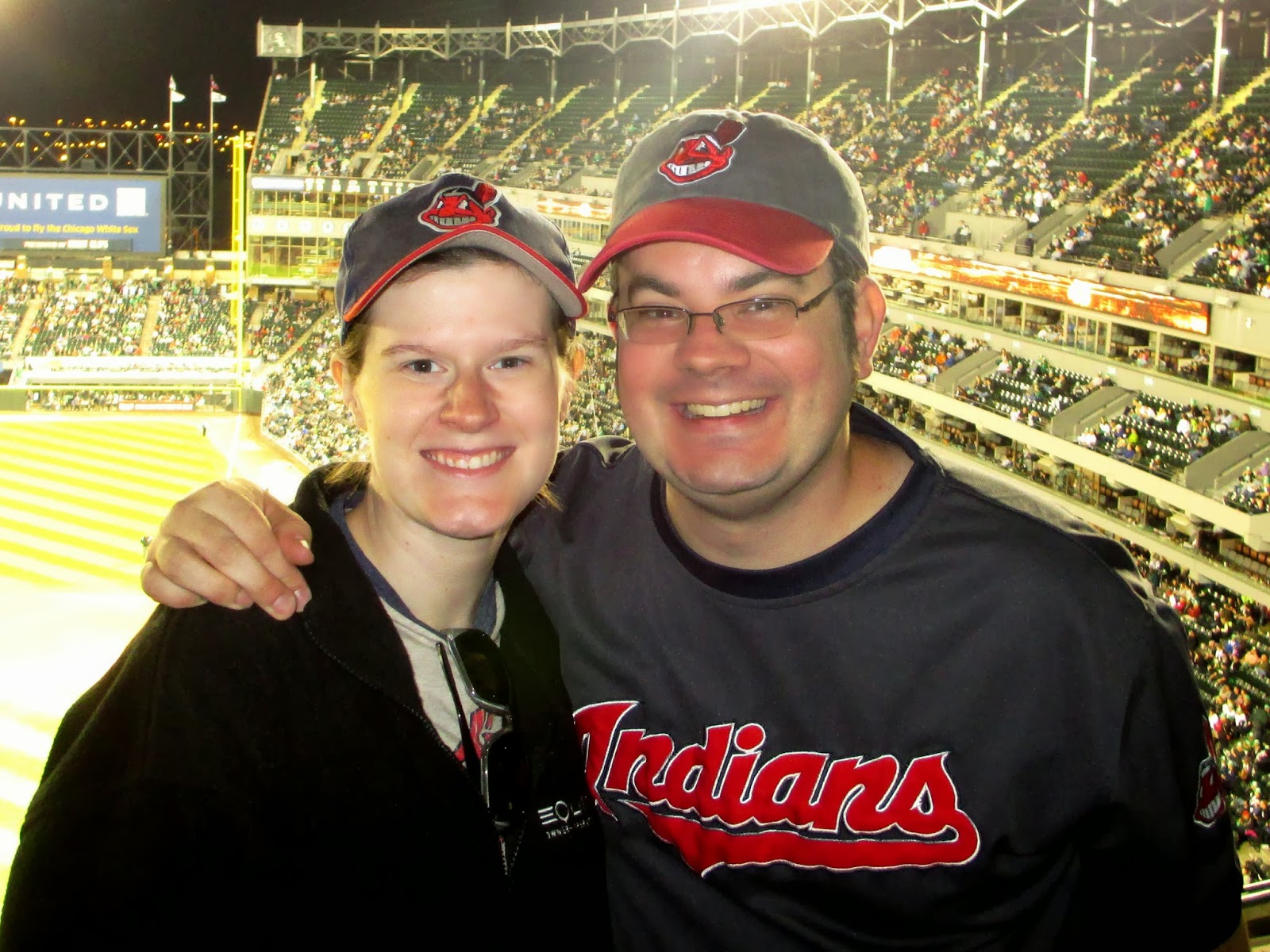
On my birthday (March 2), which is also my youngest sister's birthday, my sister Katie and I drove to Valparaiso and totally surprised Becky. It worked perfectly and she had absolutely no idea we were even coming until she opened the door and there we were! I was glad to be able to execute that plan and that it worked out for Katie and me to pull it off (thanks to some help from our brother-in-law David). I made a trip to Valpo in late July, then again in September for the annual Popcorn Festival, and then Becky, David, and I attended an Indians-White Sox game in Chicago (Indians won 7-1!!), which was a lot of fun. I returned to Valpo in November for my nephew's 4th birthday, and Becky, David, and I attended the Ohio State-Purdue game at Purdue (along with several thousand other Buckeye fans). Ohio State rolled 56-0. The game was supposed to be a "blackout" for Purdue, but there was as much scarlet (if not more) in the stands than black. It was Becky and David's first Ohio State football game ever and my first true OSU road game. The only other OSU games I've been to were their 2009 game in Cleveland against Toledo, and two home games: 1996 against Penn State and 1997 against Iowa at Ohio Stadium.


Indians at White Sox...our first visit to US Cellular Field


Ohio State at Purdue...notice any scarlet in the stands?? LOL

New family!

2013 saw the arrivals of two nieces: Olivia was born November 12 (11-12-13) in Nashville to my brother Andy and sister-in-law Heather, and Lorraine was just born December 30 just north of Valparaiso to my sister Becky and brother-in-law David. I'm hoping to meet Olivia ("Lady O") in March when I can visit Nashville again, and am fortunate enough to be here in Indiana for Christmas, so get to meet Lorraine right away!

Olivia ("Lady O"), the day after she was born. I'm hoping to see her in January and/or March!

Me with Lorraine, just yesterday (Dec. 30, 2013), about an
hour and a half after she was born

It's been great getting to spend time with my two nephews this year several times, not only my visits to Indiana, but their trips to Ohio. I've also enjoyed visiting with my niece Evelyn ("Little E"), especially being there for her first birthday in August! All my nieces and nephews are so much fun to be around and make me laugh and smile, a lot!

Niece Evelyn, aka "Little E", age 1

Nephew Ryan, soon to be 2

Nephew Nate, age 4

My sister joined the Peace Corps and left in March for Ukraine, where she'll be until mid 2015. It's been great being able to keep in touch with her so easily via Skype, Facebook, and Instagram, and even Google Voice. I'm so proud of her, though I do miss seeing her! I'd love more than anything to be able to visit her and the school she is working at in Ukraine, but who knows when, or if, that will ever be possible. One can certainly hope!

The day Katie left for DC to begin her Peace Corps training

National Anthem

While I wasn't able to repeat my 5 appearances for the Indians like I had in 2012, I still had several opportunities to perform the anthem, though in different places. I did perform for the Indians again in 2013, singing in May for a game against the Reds. I almost sang again, but it didn't happen. Had the Indians finished in a tie for one of the wild card spots and hosted that game, I was scheduled to sing. As it turned out, the Indians won the first wild card spot, and the singer for that game was determined by Major League Baseball, so someone else did it. I was a little disappointed I didn't get to sing for the tie breaker game (since it didn't happen...it would've had the Indians lost on the last day of the season), but as a Tribe fan, I was glad they won and made the playoffs. Hoping to sing in 2014 for the Tribe, though.

Cincinnati at Cleveland in May

I was able to sing for 3 minor league games. I sang for the Columbus Clippers (AAA team of the Indians) in April, the Akron Aeros (AA team of the Indians) in May, and the Toledo Mud Hens (AAA team of the Tigers) in July. The games for the Clippers and Mud Hens were my first time ever even going to games for those respective teams. I enjoyed each performance and am hopeful to sing for all of them again in 2014.

Aeros game in May

Another first for singing in 2013 was this past November when I sang for the Lake Erie Monsters, the top minor league hockey affiliate of the Colorado Avalanche. That was also my first time singing at Quicken Loans Arena in Cleveland. It was a lot of fun! Of course I have continued to sing for Kent State men's basketball games, and did a wrestling match and a women's basketball game this December. It was my first time doing a wrestling match and my first time doing a women's basketball game in a few seasons. Really, it never gets old. Every time I sing the anthem it's as exciting and enjoyable as the first time.

Lake Erie Monsters game in November, my first performance at the Q

Teaching

No progress on teaching, though 2013 was another year of change for me as far as subbing goes. I started the year out subbing in Stow, Tallmadge, and Maplewood, and ended up dropping all three for various reasons. This fall I renewed my teaching license and added the Streetsboro and Rootstown districts as well as the Bio-Med Science Academy in Rootstown, that's attached to the Northeast Ohio Medical University (NEOMED). So far I have really enjoyed my time at these new places and have worked with some really great students and teachers. Still looking for that elusive full-time job somewhere out there, but in the meantime, subbing will hopefully fill that gap.

First day subbing in Streetsboro in November...was the first time I had worked since
late May.
As 2013 ends, though, I do feel momentum heading into 2014 and that good things are in store. Obviously a new year doesn't solve problems, but it does give us a way to gauge progress and compare periods of time. I've also learned to really look at what I have that is positive and know the difference between being content and being complacent. Content doesn't mean I'm not trying to improve or make positive changes, it simply means I find the good in the current situation and build on that instead of focusing on what's wrong. That in itself has been a huge help in my outlook and motivation. Here's to the experiences in 2013, the lessons learned, and the excitement for a better 2014.

Thursday, November 28, 2013

#CharacterCounts

In my last post I alluded to the importance I place on the character of a person, regardless of their level of talent, and I want to elaborate more on that.

We live in a society that generally places a high value on certain talents. At this point in time, talents that deal largely in entertainment are valued quite heavily, such as acting, singing, and athletics. While I obviously have no problem recognizing the talents and abilities of others and taking the time to enjoy their work, I have noticed that many people out there will excuse poor character on the part of someone just because they're talented in a specific area. The most common place I have seen this is in sports, though it's prevalent in other areas too.

For instance, an article runs about the negative action or comments from a famous athlete, and you will inevitably see many comments that reference the talent of the person and/or his or her salary as reasons they can't really be criticized. Huh? So talent and money excuse decency or just being a nice person? I get that people are people and make mistakes. I don't expect perfection from anyone. But I do expect people to be good regardless of their circumstances, though I realize that is certainly not the case. All the fame, fortune, power, and talent in the world does not release or excuse someone from simple human decency.

When I speak of character, it's on the lines of how we treat each other. For celebrities or anyone who has some level of fame or recognition, it's usually how they treat those who don't have their status, whether it be fans, employees, or just the general public. Do they distinguish between the "common folk" and those with fame and fortune? Are they nice to those that "matter" but no one else? How do they interact with fans? Is their demeanor on TV real or a facade? Those are all things I look at and are part of why I don't get into a lot of "hero worship". In the end, no matter how talented or rich someone is, they are a human being just like me. There are things things that I'm probably more talented in than them and vice versa. It's simply a matter of circumstance. And yes, it may be "old fashioned", but I am a firm believer in the Golden Rule.

It is no secret that I am a religious person who believes in God. That said, I believe that we are held accountable for the gifts we have been blessed with and how we use them. God blesses people with many things, and how we use those are something that I believe he's going to ask us about. Did we use our blessings to help and uplift others, to make the world a better place? Or, did we use them to put other people down, to persecute, and for mainly selfish reasons? The other thing, from a religious perspective, that comes to mind is Matthew 25:40 where the Savior teaches us "Inasmuch as ye have done it unto one of the least of these my brethren, ye have done it unto me." How we treat "the least of these" really reflects our true character.

But even from a completely non-religious perspective, following the Golden Rule simply makes the world a better place. Most people like to be treated well by others, so it makes sense to dish out what you'd like to receive. The old adage "what goes around comes around" is so true in many aspects of life, including how we treat people and how we use our talents.

So yeah, you won't find me obsessing about some celebrity or trying to track their every move, though I do follow some on Twitter and Instagram. Like I said, they're a human being, I'm a human being. I respect their talent and recognize the greatness, but that doesn't mean I elevate that person to something above everyone else. I follow a few on Facebook, Twitter, and Instagram, but only those that seem like good people. I mentioned in my last post how many replies I saw from Phillip Phillips to his fans on Twitter. Even if he doesn't necessarily do those himself (like he has a social media specialist...I honestly don't know...I assume he responds himself), it's still an effort that will totally make someone's day. That says a lot to me about his character. There have been instances where someone I was following started posting largely negative or judgmental stuff, so I stopped following them.

I was reminded of Omar Vizquel, one of the best shortstops ever, when he came to our local Walmart to sign autographs during the Indians' heyday in the mid 1990s. We had stood in line to see another player a few months earlier and I guess we caught him at the end of the day because he looked ready to go. When we met Omar (and we didn't have to wait nearly as long), who was my sister's favorite player, he was really nice. What stuck out to me was my sister brought a copy of this birthday card she had sent to him a little while before and asked if he had gotten it. He said yes (of course I don't really believe that, but I thought it was still cool for him to say that) and then asked if she wanted him to sign it. This was one of those autograph signings where you had to pay to "raise money for charity", so him offering to do that for her was a very nice gesture. It certainly made a great impression on me and is something that totally made my sister's day at the very least.

I have started using the hashtag #CharacterCounts on posts in Twitter, Instagram, and Facebook when I see something that I think is a good example of character or for someone I'm following that I feel has positive character traits, at least as far as I can see. That doesn't mean I think that person is perfect, it just means I appreciate the fact that they're a good person (or at least appear to be) and don't use their talents and abilities to bring other people down and don't scoff at all the "fans" that admire them for whatever reasons. I've used it on inspirational-type posts, family-oriented posts, gratitude posts, or just fun posts. I have no idea if anyone else has used that hashtag before, but I hope others follow. In the end, if we want the world to be a better place, it starts with each of us and what we are willing to support and sharing that with others. Sounds hokey, but it's true. And yes, I realize that someone's Twitter or Instagram persona could be a total facade, but it's all most of us have to go on. We can at least support the positive.

Oh, and if you have no idea what a "hashtag" is, that's social media lingo for a word or phrase after the "#" symbol. When you put that in a comment or post, if someone clicks on the hashtag, everything that has that tag (and is publicly visible) will show up. So, when I put #charactercounts on something, if you click on that on Twitter, Instagram, or Facebook, you'll be able to see anything public that also has that tag on it.

Some of the "celebrities" or otherwise somewhat known people I follow that I have found to be courteous, responsive, and generally good people include Jason Kipnis, Mile Aviles, Yan Gomes, and Nick Swisher of the Cleveland Indians, Rob Gronkowski and Julien Edelmen (Edelmen went to Kent State) of the New England Patriots, Joey Bosa and Jeff Heuerman of the Ohio State football team, Coach Rob Senderoff, Chris Ortiz, and Blake Vedder of the Kent State men's basketball team, Coach Danielle O'Banion of the KSU women's basketball team, Mike Rowe of the show Dirty Jobs, Fashion designer and KSU alum Suede, Navy SEAL Chris Heben, and fitness/bodybuilding figures Ryan Smith, Greg Clausen, Brandan Fokken, Linda Durbesson, Joey Swoll, Josh Halladay, Gary Strydom, Con Demetriou, and Larry Morrison. There are several others I could list here too, but in all of these, I enjoy reading their various posts (whether they be uplifting, interesting, or just hilarious) on the different social media, and in the cases of those I have interacted with, it's been very positive.

#ChatacterCounts!

Saturday, November 9, 2013

How Can I Keep From Singing?

Thro' all the tumult and the strife 
I hear the music ringing; 
It finds an echo in my soul— 
How can I keep from singing?

The words above come from the hymn "How Can I Keep From Singing", by Robert Lowry, well known in Christian music. It's a song I have performed before and love, not only because of the melody, but the words itself, especially the repeating question, "How can I keep from singing?"

Anyone who knows me personally knows I love to sing, and while it may come across as arrogant or conceited, I'm pretty good at it too, at least as far as I've been told on many occasions. Because it's something I feel I'm good at, and something I enjoy doing, I try to take advantage of every opportunity to perform that I'm given, and am always looking for additional opportunities to sing, whether it be in church or singing the National Anthem for a sporting event. If I could ever sing for a living, I would totally take it.

Lately, though, I haven't had as many chances. I was fortunate enough to get to sing with some of the past casts of This is Kirtland! on two occasions in October where I had a small solo in each, but that's it since singing in church a few Sundays ago. My most recent National Anthem performance was July 27 in Toledo. There are a variety of reasons for the drop off, but suffice it to say, I am most certainly looking for opportunities wherever I can find them, in earnest now.

Performing, but especially singing, is apparently totally embedded in me. It's something I have to do. The last few days, it's been physically painful to see other people perform, not because of their performance, but because I'm not performing. Again, how can I keep from singing? It's not possible for me.

Last weekend while I was in Valparaiso, I heard the song "Home" by Phillip Phillips. I had heard the song several times, mostly on HGTV for this one commercial that airs during almost every show. I heard it playing when we took my nephew to Chuck E. Cheese's for his 4th birthday and remembered that I had been wanting to find out what that song was and to hear the entire thing. Thanks to my smartphone, I was able to plug in a few of the lyrics, find the song, and download it pretty quick. 

Now, you should know that I'm not someone who typically follows specific artists. People always ask me what kind of music I listen to or what my favorite groups are, and my reply is simply: if I hear a song and I like how it sounds, I'll find out what it is and download it. In doing so, I may find out that artist has other songs that I enjoy, especially if I learn about that artist.

Such was the case with Phillip Phillips as I learned a little about him and how he won American Idol last year. I've never really gotten into American Idol mostly because the times I did watch, it seemed more about making ratings than producing good music. I was particularly turned off by some of the ways the judges would express their opinions when something wasn't as good as they thought. No need to be nasty, but I get it, it was so people would "talk about it" and watch for those kinds of reaction (kind of a sad reflection on our collective society, though). I did consider auditioning for it when they came to Cleveland back in 2005 (YIKES, was it that long ago?!?), but the thought of having to camp out at Browns Stadium just to wait and then have a slim chance of doing much of anything turned me off. Looking back, I don't regret that because I don't think I would've had a good audition anyway. I learned SO MUCH more about my voice in the years right after that. It wasn't that I wasn't capable then, but I feel so much more capable now as a vocalist.

Anyway, I read a little background on Phillip Phillips and watched the YouTube clip from his audition on Idol that showed a little more about where he was before the audition. To be honest, I like his voice, and the two songs of his that I've downloaded, "Home" and "Gone, Gone, Gone", are a style I enjoy listening to, singing with, and even moving to. His story is pretty cool too and he seems like a genuine good guy, not some douche who's let fame go to his head (and yes, the character of a person is more important to me than their talents!). Just a glance at his Twitter, I saw he replies to a lot of Tweets from fans. That says a lot about his character to me just taking the time to make someone's day like that. 

Seeing that, though, definitely has me thinking, "why not me?" Absolutely nothing against Phillip Phillips (in all honesty, I would love to perform with him if that was ever possible...and he can run circles around me with his guitar skills), but more a realization of my own talents and abilities. I will say those two songs, "Home" and "Gone, Gone, Gone", were very inspirational to me, not because they were simple or easy, but because they are uplifting and upbeat. I can't listen to and/or sing them without feeling good and smiling. 

That said, look for some recordings from me. Nothing fancy yet since I have incredibly limited means that prevent any kind of professional recordings. Even so, I do have a good mic and recording capabilities to produce decent recordings. If you like them, feel free to share them. At this point, I have some a Capella recordings of me doing the "Star-Spangled Banner", "O Canada", and "God Bless America" mostly for audition purposes for sporting events. I also have two recordings of the Tenor solos I had in The Messiah last year ("Ev'ry Valley Shall Be Exalted" and "Comfort Ye My People"). These are on my SoundCloud site (https://soundcloud.com/jon-ridinger). I also have videos from my various National Anthem performances through the last few years on my YouTube page (http://www.youtube.com/jonridinger). If you like them, please share them with people you know. Never hurts to be heard. I also don't mind constructive criticism and/or suggestions. 

Tuesday, October 15, 2013

Traditions

I've been thinking a lot about the various traditions I encounter in the Church, especially the last few days. Anyone who's followed this blog knows I have written about this before, particularly understanding the difference between doctrine and tradition (and between doctrine and policy and between policy and tradition). The following are the ones that have been on my mind recently, though by no means is this the first time I have thought about them. Take my opinions of them at face value. In no way does my opinion affect my testimony and feelings about the doctrine itself.

Standing when an apostle enters a room
This was most obvious this past Friday when I was at a special meeting in Kirtland to commemorate the 10th anniversary of the dedication of the Historic Kirtland village. Elder M. Russell Ballard was in attendance, as he was also in town for the Kirtland Ohio Stake Conference the following two days. I was at this meeting as part of a choir made up of cast members from all different years of This is Kirtland! as we performed two of the songs from the show. I even had a solo in one of them!

The meeting started at 7:30 but I was in the building an hour early. Just before the meeting was about to begin, Elder Ballard entered the chapel and everyone stood up and the room went silent. I knew this would likely happen as this was hardly the first time I've been at meetings when an Apostle was present. Previously I'd been at sessions of General Conference in Salt Lake City, plus I attended two meetings where Apostle Richard G. Scott was present: one on my mission and then another about 2 years later here in Ohio when he attended our Stake Conference for the Akron Ohio Stake.

I personally don't understand the purpose behind the silent standing. From what I have heard it is somehow viewed as a sign of respect, but I don't personally see how that signifies respect. Yes, I believe Apostles are called of God and stand as special witnesses of Jesus Christ, but I still recognize that they are human beings. There is certainly no doctrinal basis for standing up as it's clearly a tradition. While I don't think it's bad, per se, I can easily see how it could be misinterpreted, especially in a meeting like I was at. And yes, I know that standing for many other things is for respect, like for the flag or the National Anthem, or even in a courtroom.

The meeting I attended was definitely an LDS meeting, complete with prayers and hymns, but it had several non-LDS dignitaries in attendance as it was just as much a community event as it was a church event. Seeing everyone stand and go silent until Elder Ballard got to his seat and sat just looked very bizarre, especially from a non-LDS perspective. If I were an apostle, I'd definitely ask people to NOT do that.

I saw it happen at a non-church event that was hosted in the LDS Conference Center in Salt Lake City. When I was a student at BYU-Idaho, I attended the regional American Choral Directors Association convention in Salt Lake. Part of the program was a concert by the Mormon Tabernacle Choir in the Conference Center that all the delegates were invited to and got to go on stage to sing Battle Hymn of the Republic with the choir. Right before the concert started, President Thomas S. Monson entered the room (he was first counselor at the time) and many people started to stand in silence as he walked to his seat. I remember some people behind me asking each other what was going on and then realizing it was one of the Mormon leaders. They didn't say anything rude or disrespectful (not surprising considering quite a few people around them were standing!), but they clearly thought it was bizarre. Is that what we want? To make people just think we're weird or mindless?

Clapping in the chapel
Anyone who's been to an LDS meeting knows we don't clap in our worship services, whether it be for a great talk or a musical number, we are pretty subdued. The church's official Handbook of Instructions specifies that "Applause is not always appropriate in the chapel." While that is clearly not doctrinal itself, it's based on the idea of reverence and keeping the chapel a reverent, peaceful place. What has happened, though, is that MANY in the church interpret "not always appropriate" to mean "never."

This only becomes an issue when the chapel (which many other churches would refer to as a sanctuary...the main meeting room) is used for events that are not sacrament meetings or other religious services. For instance, chapels can and are often used for recitals and concerts or for presentations. All events in the chapel have to meet certain standards (so no political rallies, rock concerts, etc.), but that does not mean applause is never allowed or even appropriate.

This was actually somewhat of an issue in that same meeting this past Friday. Near the beginning, one of the Lake County Commissioners presented the local church leaders with a proclamation commemorating the 10th anniversary of the Historic Kirtland village and highlighting the church's role in the county's history, present, and future. At the conclusion, it was met with the typical silence that pretty much every event in a Mormon meeting ends with. Thankfully, some of those around me and then I started clapping and others joined in. Because I was sitting on the stand, I could see the audience and I could clearly see people looking uncomfortable clapping in the chapel, like somehow they were sinning or something. It was just a simply applause to acknowledge the proclamation, not irreverent or loud. Applause was most certainly appropriate there, especially in light of the fact that not only were lots of people present who aren't LDS, but the commissioner isn't LDS either, so instead of seeing it as an expression of LDS culture, it instead just looks, again, bizarre.

The same was true when we did a multi-stake performance of Handel's Messiah. At one of the performances, audience members were specifically asked not to clap at all, even at the end of the performance. We sang the Hallelujah Chorus, everyone is standing, it ends, and just silence. Tons of non-LDS people in the audience, a natural reaction to want to clap, and nothing. It was so awkward. The leadership thought they were respecting the reverence of the chapel, but instead they were just making Mormons look weird, and for no reason at all since applause is not forbidden in the chapel, doctrinally or procedurally. Again, tradition trumped actual procedure because it was viewed as doctrinal, even though it clearly wasn't.

The Sabbath and money
Latter-day Saints, for the most part, take the Sabbath Day seriously as a day to attend church and rest. We are counseled to avoid working where possible and to avoid doing things like going shopping, going out to eat, entertainment, sports, etc. It is supposed to be a day of rest not only for you, but for everyone. Of course most people in the world don't adhere to that, so many of us do the best we can.

Like any counsel, there are Latter-day Saints who take the Sabbath to the extreme, like wearing their church clothes all day (I'm not talking about doing so just because they don't feel like changing, but doing so because they think it's more righteous), or completely avoiding television and/or the radio.

Now, I will say that overall, keeping the Sabbath is a very personal thing. Obviously there are some pretty clear cases of what to do or not to do, but for the most part, it's a personal matter. So, if someone feels like they need to stay in church clothes all day or completely avoid TV, that is certainly their right, though you certainly won't see me doing that! Where they cross the line is if/when they present their choice or preference as more righteous, like not doing that is somehow "breaking" the Sabbath.

This often comes up with the idea of spending money. Like I said, we are counseled to avoid going shopping, out to eat, etc. on the Sabbath (which is Sunday for LDS in most of the world), but I have noticed many people have interpreted that to mean we should avoid spending money on the Sabbath. We realize that many businesses are open on Sunday and stay open because they get a lot of traffic, so our abstinence from shopping on Sunday is simply a matter of principle. But with the arrival of machines and the Internet to do shopping, is spending money actually making people work? In my opinion it isn't, at least in most cases.

For instance, if I go to a website and order something, while there is a possibility the order may be taken right there, chances are it won't be. Sunday is not considered a "business day", so most times, any order made during the weekend is simply taken care of Monday morning (websites will often state something to that effect on the ordering page). Websites do not need to have constant supervision or someone manning the resgister. Obviously the same is true for anything bought from a machine, like pop (soda), snacks, or even a newspaper. No one has to work if you choose to buy something and there is certainly no doctrinal basis that spending money on the Sabbath is somehow sinful. Heck, even some gas stations can operate without anyone inside since many have card readers right at the pump that can function without anyone in the store (though, in all honesty, I avoid getting gas on Sunday unless I absolutely have to).

Now, like I said earlier, the Sabbath and "honoring it" or "keeping it holy" is mostly a personal matter. If people are uncomfortable buying things via a machine or online because somewhat might have to work as a result of their purchase, hey, no shame in waiting until Monday or doing it on Saturday. But don't tell me I'm "breaking" the Sabbath because I bought something online on Sunday or put a dollar bill into a vending machine.

In closing, I can understand being "peculiar" for things I know are doctrine, but for traditions? Um, let's examine them and make sure they have a rational purpose behind them and that in the process of standing for what we believe in, we aren't totally "weirding out" the world around us. That doesn't mean we get rid of traditions all together, but it does mean we don't mindlessly do them. I'm all for traditions and following procedure, but let's please make sure they have clear purposes and aren't confused with doctrine. Following doctrine is a must, following procedure is highly recommended (though "spirit of the law" vs. "letter of the law"), and just following tradition should be done with caution and understanding, as well as differentiating between the three.

Wednesday, October 9, 2013

An open cover letter

Looking for a good addition to your company or organization? Look no further. While my resume has been posted online for some time, and I maintain a LinkedIn profile, there's a lot more to me and my experience than just what is contained there.

Photo credit: Janelle Nutter, Square Root Photography

I can assimilate information quickly
A quick glance at my resume shows that I have had quite a bit of experience as a substitute teacher, so far at four different districts, which includes a total of nearly 20 different school buildings. That means on a given day, I not only have to remember the policies and routines of a particular building, which can vary even within the same school district, but also that of a specific classroom. In most cases, I walk into a classroom with little, if any, previous experience there and have between 10 and 30 minutes to absorb the lesson plans for the day, class rosters, any potential fire or tornado drill instructions, and any other rules or instructions that may have been left. Instructions can be as simple as a few lines ("give students this worksheet and have them complete it") to multiple pages long (such as an elementary school classroom). I have worked in environments where I'm one-on-one with students to environments where I have upwards of 60-70 kids in a room at the same time. There are even days where I spend part of the day at one school, then totally change gears and spend the rest of the day at another school in a totally different class.

So yes, subbing is far more than simply glorified babysitting that anyone with a pulse can do. It often takes quick thinking, staying on your toes, and being able to assimilate all that information quickly so that decisions can be made not only quickly, but carefully, which can be applied in many other workplace situations.

I can troubleshoot
Troubleshooting, of course, doesn't mean I can fix every problem I encounter, but at the very least, I can identify the problem and the best person or solution to fix it if I can't do it on my own. This is anything from troubleshooting simple computer problems (which I have done at home on a regular basis and even at some of the schools I sub for), to physical maintenance problems, to personality issues. This is part of my abilities to solve problems, whether it be a simple physical fix or some sort of compromise between two parties, or even just calming people down and discussing an issue, which plays into my next quality.

I am level-headed
Emotion can be a very powerful tool that drives people to complete tasks they may have otherwise failed at for a variety of reasons. On the same page, though, if not used correctly, emotion can cause people to make rash and illogical decisions. I am someone who can make a quick decision when needed, but can also weigh the evidence, the possibilities, and potential long-term ramifications. That's not to say I lack opinions, but my opinions are based on evidence and are subject to change based on additional evidence that may be brought to light. So, in a heated argument, especially one that is more ideologically-based, I will certainly have my beliefs and opinions, but not to the point of belittling others who disagree or disrespecting an opposing viewpoint. That said, it is also important for me that when I do make decisions, I can logically explain my reasons so that even if you disagree with what I did, at least you understand why I made the decision and that it wasn't made flippantly. I expect the same out of those around me too. It's great to have beliefs, but be prepared to defend them with logic and reason and not a lot of emotion.

I'm detail-oriented
Details are what sets things apart. In my experience as a teacher and presenter, that means going the extra mile in preparing materials for students and guests that help them not only memorize the info, but understand it far better than they did before my class or presentation. In a presentation I did in 2012 about a local historic building, the details I added were photos from old yearbooks, photos from places in the building that few had seen, and going into old newspapers and finding information that had long since been forgotten. I even had tour guides throughout the building pointing out subtle but still visible reminders of changes made in the building to help guests get a feel for its history.

Example of graphic used for a presentation I gave in 2012. Blue numbers indicate where tour guides stood to point out specific features, red arrows were entrances we needed opened by the custodial staff, while the yellow areas indicated to the school district which rooms we needed to use.

As a director of a musical theater production this past summer, my attention to details was manifest in making things on stage like facial expressions, cast members staying out of view of the audience while not on stage, lights being aimed perfectly (and centered if it was required), and annunciation. Outside the stage, it included doing the playbill myself to make sure information was in a logical order for guests, and organizing a photo shoot for the cast and crew to have professional head shots taken for a display.

While I did not personally make this, it was something I made sure happened. Thankfully, I was able to find a photographer (Janelle Nutter of Square Root Photography) who had the same vision and attention to detail I did to make this become a reality

In my personal life, details are in making sure pictures hung on the wall are straight, paint on the wall is even, the lines between the ceiling and walls are straight, and colors are balanced in any kind of decoration. It's also about keeping a daily journal (currently on volume 16), and making sure I use correct punctuation and grammar in all communication. And yes, I am often asked by friends and family to proof writing and even things like posters not only for correct spelling and grammar, but clarity in organization, use of color, and font size. I have used those skills on Wikipedia too, including a Featured Article on Kent, Ohio.

A picture collage I put together at home, making sure the frames were straight and spaced out evenly

I have managerial experience
As I mentioned previously, during the summer of 2013, I directed a local musical theater production. It was my first time ever taking on such an endeavor and it proved to be quite a challenge. Not only did I have to worry about the theatrical aspects of the show (who does what part, where they stand, how they act, etc.), but I had to worry about virtually every aspect of the show from the technical, to the music, down to the programs. That's not to say I did everything because I most certainly didn't. I had one dedicated crew and a group of people who were not only reliable, but bought into my overall vision for the show. Total, I had a cast of about 60 people, over half of which were children and teenagers, plus a full orchestra, and a crew of about 10. We had eight total performances and saw a noted increase in attendance from years prior, on top of a multitude of positive feedback from audience members and former cast members who attended (this was the 10th season of the show).

Early rehearsal, May 2013. Photo credit Lisa Lovato

As a substitute teacher and in my other teaching experience, I have had to tap into my managerial experience as well. When you're responsible not only for the education of children and teenagers but their well-being, that involves managing who is in the room, making sure they're on task, and knowing what to look for and how to motivate. As a sub, obviously that can change radically from day to day, such as managing an elementary gym class compared to a high school Advanced Placement English class.

I'm computer literate
I have been using computers since I was in elementary school and my grandma had an old Commodore 64. We got our first computer in the mid 1990s when I was a freshman in high school, so I have grown up not only using computers, but getting to know the various programs and operating systems. I'm more familiar with Windows than Macs, but that's mostly due to circumstance. I have extensive use and understanding of Microsoft Word, Publisher, and Excel, and even programs that I may not be as familiar with, I can pick up rather quickly with a simple tutorial, doing a web search for help, or just trial and error. I have done tons of scanning for presentations and personal use, and am an avid amateur photographer.

In social media, I have been on Facebook since 2006 and also have a Twitter account that I have started using more frequently. On Facebook, I have experience running and contributing to official pages, including the one for the musical I directed. I already mentioned my LinkedIn profile, plus I have this blog, my history blog, and even a personal blog. I am also a regular Wikipedia editor, and have written articles, edited others, and contributed scores of photos and graphics to use in all sorts of articles there. That alone requires attention to detail, working with others, and understanding policies and norms.

Finally
Although I have a teaching license, that shouldn't let any perspective employers shy away from contacting me for opportunities that may be outside the realm of education and/or music. I seek any kind of job opportunity that I can use my skills and feel like I am making an important contribution. I am, however, not interested in any kind of direct sales position, basically a job where my pay is dependent on the choices of others and whether I can convince them to buy some service or product. While I have no problem promoting products and services I have used (I occasionally do that right here on my blog), sales jobs such as selling insurance or cars are not something I would excel at. Even so, I am always open to propositions. Please feel free to contact me using the links on my resume or LinkedIn profile.

Oh, and did I mention I can sing too? Not that it would make a difference in most companies, but you never know. I have done the National Anthem for the Cleveland Indians multiple times (most recently in May 2013 and was scheduled to sing for the tie-breaker game had the Indians needed that at the end of September) and have done other teams like the Toledo Mud Hens, Akron Aeros, and Columbus Clippers, and of course, my hometown and Alma Mater Kent State!

Wednesday, October 2, 2013

Roosevelt to the Suburban

Most of you who know me know that I take an interest in high school sports. I wouldn't call it an obsession, but I do attend high school sporting events fairly regularly and keep tabs on the happenings in the high school sports world. Playing along with my history interests, I'm also interested in the history of high school sports, and was recently referenced in an article in the local Record-Courier about the long-standing rivalry between Theodore Roosevelt High School in Kent and Ravenna High School.

The biggest news recently, outside the Kent-Ravenna game this past weekend, was the announcement that Roosevelt will be leaving the Portage Trail Conference (PTC) and joining the Suburban League in all sports. The initial announcement said it would be in 2016, but seeing as every other school has indicated 2015, I won't be surprised to see that change for Roosevelt either. As the announcement has come about, I've noticed a lot of the same questions in comments, the biggest, of course, is why? Also, people are wondering about the rivalry with Ravenna.

First, in addressing why, the answer mainly lies in the issue of competitive balance. Money is somewhat of an issue, but not in terms of making more money, but rather spending less. Athletic conferences in Ohio are designed to make sure schools have regular scheduling partners who are of similar size and relatively close distance. The move from the PTC to the Suburban doesn't really represent much of a change in travel costs--in reality it will probably increase travel costs slightly--but it does represent a change in competitive balance.

The Suburban League, in its new configuration, will be set up the same way the PTC is: two divisions that are determined by a school's enrollment. As enrollment numbers change, a school's position can also change. In theory this works, but in reality, what I've seen so far is the break between the "big school" and "small school" divisions isn't usually that big, so the schools at the bottom of the "big school" division are often better suited for the "small school" division or vice versa. In the PTC, though, you have Roosevelt well ahead of any other school in enrollment. Typically, Roosevelt is around 1,300 students while the next largest school is around 900 (that can be Ravenna, Norton, Springfield, or Coventry, all of which are roughly the same size). Roosevelt is nearly twice the size of Crestwood and Field, which have about 700-750 students each. In the new Suburban League, the enrollments will be much closer. All of the schools in the "small school" division, of which Roosevelt will be a member, are between 900 and 1,300. Copley, Cloverleaf, Barberton, Highland, and Revere are all schools with over 1,000 students while Aurora and Tallmadge are both around 900.

Why does that matter? While having more students is no guarantee a school will always have better sports teams, mathematically, it means that in most years, they likely will. More students means a larger pool of talent. Sure, you'll always have smaller schools that buck the trend or that have a particularly talented group of athletes come through every so often. But in the long run, there is a much better chance that the large school will be more competitive more often. That is why the state divides sports into divisions based on enrollment, so more schools have the opportunity to play for state championships against similar schools.

In football, where there are 7 divisions now (the number of divisions depends on the sport), with the largest schools being Division I and the smallest in Division VII. Ohio uses a computer system to determine who makes the playoffs. Within each division are 4 regions and within those regions, the teams are given computer points. While winning always gets a team those valuable computer points, beating a team from a smaller division means you get less because the computer expects the larger school to beat the smaller school. This was most evident in 2010, when Roosevelt and Ravenna were both in Division II for football (which is not the case this year). Despite Ravenna beating Roosevelt head-to-head and winning the PTC Metro that year, Ravenna missed the playoffs, finishing 9th (top 8 qualify) just behind Roosevelt. Roosevelt's early-season wins over Division I Stow and Division II Kenston off-set Ravenna's wins over smaller schools by just the slightest, but enough to send one to the playoffs and not the other.

Those football points, right now, largely work against Roosevelt since it is the largest school in the PTC. This year and next, it will be the only Division II football school while the rest are all Division III. It's not an issue if the team goes 9-1 or 10-0 or even 8-2 (this year they are 4-1 thus far). But 7-3 and 6-4 records will look a lot better to the computers coming against fellow Division II schools like Copley and Barberton than they will against Division III schools like Crestwood and Field.

Another aspect of the size differential is the additional sports that don't have a home in the PTC. Roosevelt has almost 30 varsity teams. Boys volleyball, boys and girls lacrosse, boys and girls swimming & diving, girls golf, ice hockey, and girls field hockey all play in other leagues because not enough (or any) schools in the PTC have teams. Playing in other leagues increases transportation costs for most of the sports because the teams generally have to go outside the area of the PTC to find leagues to participate in. A move to the Suburban will find homes for most of the above listed sports, with the exception of ice hockey. Of the sports listed above, the only other PTC schools to have them are Crestwood with boys and girls swimming & diving and Southeast with a girls golf team.  For all the others, Roosevelt is the only PTC school to offer that sport.

So, what happens after this? The first question most people have is in regards to the rivalry with Ravenna. In the new Suburban League, Roosevelt will have 7 league games and 3 open spots for non-league games. I have to believe that Stow will remain one of those 3 (Stow is also joining the Suburban League, but will be in the large school division, so the game won't count as a league game) just because of the money aspect. Stow coming to Kent and especially Kent going to Stow is a huge money-maker for both schools' athletic departments, so I don't see it ending anytime soon as long as it remains competitive.

The same is largely true with the Ravenna game. It is still competitive and will likely remain a revenue-producer for both schools for some time. While the magnitude of the game may lessen by the schools not being in the same conference (meaning you won't have a game like 2011 that decided the PTC Metro title), there will always be the long-standing rivalry between the two communities regardless of whether or not it's a conference game.  The only way I could see the Kent-Ravenna rivalry ending is if it becomes non-competitive. Even if that would happen, it would likely take a very long period of domination by one school to bring an end to the football rivalry. In other sports, I think Roosevelt will continue to schedule Ravenna as non-league, again, because of the overall rivalry and the interest it generates. About the only change might be just one meeting in basketball each season instead of two, but anything is possible.

This move will affect other rivalries too. I would say a rivalry was definitely developing between Roosevelt and Field in several sports and also with Streetsboro, at least in boys basketball. I anticipate both of those rivalries will come to an end, though Streetsboro may remain a boys basketball non-league game (which it has been for a number of years and likely will be again this year since Streetsboro is back in the PTC County). I don't see Roosevelt scheduling Field in sports beyond Cross Country and Track if at all, which is how it used to be before the formation of the PTC.

Conversely, I definitely foresee a rivalry developing with Tallmadge. Right now, Tallmadge's big rival is Green, but Green is leaving the Suburban (which is what largely caused this all in the first place), plus Green isn't adjacent to Tallmadge like Kent is. While I don't see a rivalry with Tallmadge ever eclipsing Ravenna, I easily see it becoming a strong one, especially from the perspective of Tallmadge since they will have no true rival and if both remain competitive in football. Tallmadge and Roosevelt were longtime members of the old Metro League until 1990 and periodically play each other in boys basketball and a few other sports.

Barberton is another old rival that Roosevelt knows well. Barberton was a member of the old Metro League and then the WRC South, so it's only been 8 years since the two were league rivals. While there has never been a fierce rivalry with Barberton on the level of Ravenna or even Stow, there was clearly a rivalry between the two in their old Metro and WRC days, though seeing as the old Metro only had 5 teams at the time it finally merged to form the WRC, every team had a rivalry of sorts with the other. Barberton also has some of the most intense fans in the area (especially for basketball) and travels well. When the PTC was looking to expand about a year ago to replace Windham and East Canton, I was hoping Barberton would join, but the PTC ended up not expanding at all.

That leads to the next topic: what's next for the PTC? As I said, the PTC avoided expansion two years ago when Windham and East Canton announced they were leaving, mostly because there weren't a lot of viable alternatives. It's clear the PTC doesn't want any larger schools, but instead, seems to want to add smaller schools so that Southeast, Streetsboro, and Woodridge can all be bumped into the Metro Division. Right now, in addition to the gap between Roosevelt and the rest of the Metro, there is a noticeable gap between Southeast, Streetsboro, and Woodridge and the rest of the County Division. In other words, Roosevelt leaving may be a blessing in terms of organization and achieving the balance the PTC wants.

Two smaller schools in Geauga County, Cardinal and Berhshire, have already been mentioned as possibilities since those two are leaving the Chagrin Valley Conference soon and have expressed interest. Even if that happens, it still leaves one more opening. When the PTC debated replacing Windham and East Canton, 4 schools applied: Northwest in southern Summit County, St. Thomas Aquinas in Louisville, Lake Center Christian School, and Barberton. Barberton is off to the Suburban again, so they're obviously not in the picture, and Northwest would likely be in the Metro Division. Lake Center Christian would be the smallest school in the PTC, but they don't have a football team, which makes them rather unattractive. The problem St. Thomas Aquinas presents is that they're a private school, so my guess is that other PTC County Division schools would feel (and likely be) at a disadvantage against St. Thomas since St. Thomas can draw from a much wider pool of talent even if they have a similar-sized enrollment as other PTC County schools.

Although the PTC area is almost surrounded by smaller school districts, most of them are in conferences that are stable, so there is no pressing need to change affiliations. With that in mind, it may be difficult for the PTC to get back to 16 teams. They could still function at 15 and have the County with 7 and the Metro with 8. While less than ideal for scheduling, it is hardly impossible, and it would largely solve the enrollment disparity that currently exists in both divisions.

Overall, I hope it's obvious that I think this move is a good move for Roosevelt, the PTC, and the Suburban League. The Suburban League was having some enrollment disparities of its own, so this allows them to address that on both ends. For Roosevelt, it allows them to compete and associate with schools that are more similar than those in the PTC, not only in terms of enrollment, but also facilities, and gives more sports a home league. For the PTC, it allows them to also address the enrollment disparity in both divisions. People forget that Roosevelt wasn't in the initial wave of invitations that brought about the PTC from the old Portage County League. It was only after Roosevelt was faced with the option of staying in the old WRC and having to deal with increased travel costs and being the smallest school in the league that they pursued membership in the PTC. Had Barberton not left the WRC when it did, I don't think Roosevelt would've either.